Blog · A home network run like a small office
Teaching the hub to stop crying wolf
Three changes that cut false alarms without hiding real ones.
In this series · Chapter 3, MonitoringShow all 49 partsHide the list
1. Where it started
- 01Why I'm running my home like a small office
- 02What a read-only audit of my network found
- 03The first changes, and the ones I said no to
- 04Reuse first, build only what's missing
- 05Fifteen decisions before the first line of code
2. Remote access and keys
- 06One way in from outside
- 07An address that keeps itself up to date
- 08Where the passwords live
- 09Keys that can do one thing
3. Monitoring
- 10Is it my network or the internet provider?
- 11A watcher outside the house, and backups I've restored
- 12The drill that found the bug
- 13Alerts that only reach my phone when something needs me
- 14I had the monitor audit itself
- 15Teaching the hub to stop crying wolf
4. The network redesign
- 16"Don't take down my internet": the routine before every change
- 17The firewall upgrade, two days late
- 18Keeping the plan when the builder wanted to drop it
- 19Two Wi-Fi drops, and knowing when to stop
- 20The router at 90 percent
- 21Moving 40 gadgets without touching each one
5. The media server
6. The control center
- 24An overnight prototype, and bars instead of dials
- 25A nice hub, tucked away in a drawer
- 26Instructions for a phone I don't own
- 27Three checks before anything goes live
- 28Buttons with a seatbelt
- 29Rewind: replaying a Wi-Fi outage
- 30"I just want a more sensible layout"
7. Security
- 31A security scoreboard that started at a D
- 32Who's knocking: a security tab in two evenings
- 33Matching every program to the public flaw lists
- 34A DNS log for the house
- 35A weekly scan that can't annoy anyone
- 36The week of the scary flaw list
8. A private AI assistant
9. How the work got done
- 38Keeping a non-developer in charge
- 39A house manual that rebuilds itself every night
- 40My AI assistant keeps blocking itself, and I'm glad
- 41What it cost, what's next, and what I'd bring to an office
10. After the rebuild
- 42The backup that filled its own disk
- 43Two messages, one second, wrong order
- 44My help tool said "fine" at 7 megabits
11. Groceries
Eighteen days in, the hub's alerts were good but not quiet enough. Three changes in the last week of the project cut the noise further, and each one came from real data, not guesses.
1. Slowness from our own traffic goes in a weekly summary
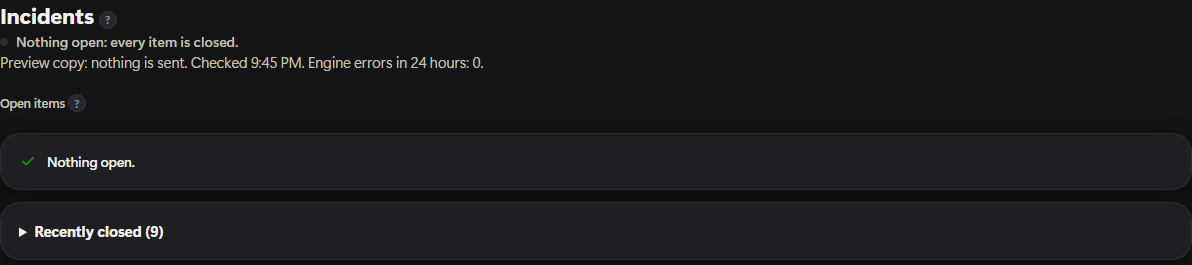
The incident counter had a yellow "1" on it almost all the time. I asked, "What am I supposed to do with lag?"
The data answered. All 6 lag incidents in the past 14 days were a busy line from our own traffic, adding 41 to 57 milliseconds of delay for 12 to 19 minutes at a time. None needed anything from me. The assistant offered a few options, and I picked a weekly summary. Lag from our own traffic is now a line in the weekly digest. Lag from the provider's side can still raise an alert when it matters.
2. Hold the alarm when everything vanishes at once
On October 19, the router's management app restarted, and at 8:37 AM my phone got 4 alerts that devices had gone offline. They hadn't. During that restart, all 5 switches and Wi-Fi points stopped reporting within a minute, while a test device kept answering 120 of 120 checks. The network was fine. Only the reporting had paused.
The new rule: if 3 or more devices vanish within 5 minutes, all of them come back within 10, and the test device keeps answering the whole time, the hub holds the offline alarm. On the map, those devices show as "Checking in" instead of offline.
Before trusting the rule, the assistant replayed it against history. On October 19, 9 offline readings would have become 0. On October 18, a real outage of a Wi-Fi point, late that night, was still caught. A rule that hides real outages is worse than noise, so that second check mattered as much as the first.
3. "That was ours"
A lot of alarms come from things I did on purpose: a backup, a scan, a restart. Alarms in the hub now have three marks: "That was ours," "That was fine," and Undo. Marking one teaches the hub what normal looks like. I use it to label the assistant's own backups and scans, so they stop looking like strangers.
The pattern
Each change followed the same steps. Notice the noise, pull the real numbers, decide what I'd want, write a rule, and test the rule against history before turning it on. None of it made the monitoring less sensitive. It made it more specific.
When people start ignoring an alert, it's tempting to turn it off. I'd rather pull the last few weeks of it, ask what each one needed, and change the rule to match. Then I check the new rule against a real past outage, to be sure it still catches one.