Blog · A home network run like a small office
An overnight prototype, and bars instead of dials
A working prototype by morning, four rounds of feedback, and a design choice I took back.
In this series · Chapter 6, The control centerShow all 49 partsHide the list
1. Where it started
- 01Why I'm running my home like a small office
- 02What a read-only audit of my network found
- 03The first changes, and the ones I said no to
- 04Reuse first, build only what's missing
- 05Fifteen decisions before the first line of code
2. Remote access and keys
- 06One way in from outside
- 07An address that keeps itself up to date
- 08Where the passwords live
- 09Keys that can do one thing
3. Monitoring
- 10Is it my network or the internet provider?
- 11A watcher outside the house, and backups I've restored
- 12The drill that found the bug
- 13Alerts that only reach my phone when something needs me
- 14I had the monitor audit itself
- 15Teaching the hub to stop crying wolf
4. The network redesign
- 16"Don't take down my internet": the routine before every change
- 17The firewall upgrade, two days late
- 18Keeping the plan when the builder wanted to drop it
- 19Two Wi-Fi drops, and knowing when to stop
- 20The router at 90 percent
- 21Moving 40 gadgets without touching each one
5. The media server
6. The control center
- 24An overnight prototype, and bars instead of dials
- 25A nice hub, tucked away in a drawer
- 26Instructions for a phone I don't own
- 27Three checks before anything goes live
- 28Buttons with a seatbelt
- 29Rewind: replaying a Wi-Fi outage
- 30"I just want a more sensible layout"
7. Security
- 31A security scoreboard that started at a D
- 32Who's knocking: a security tab in two evenings
- 33Matching every program to the public flaw lists
- 34A DNS log for the house
- 35A weekly scan that can't annoy anyone
- 36The week of the scary flaw list
8. A private AI assistant
9. How the work got done
- 38Keeping a non-developer in charge
- 39A house manual that rebuilds itself every night
- 40My AI assistant keeps blocking itself, and I'm glad
- 41What it cost, what's next, and what I'd bring to an office
10. After the rebuild
- 42The backup that filled its own disk
- 43Two messages, one second, wrong order
- 44My help tool said "fine" at 7 megabits
11. Groceries
Once the design decisions were made, I asked for something ambitious. At about 12:15 AM on October 9, I asked my AI coding assistant for a working prototype by morning.
By morning, I had one. Seven technical pages and a phone-sized family view, running on real data from my own network.
Real data changes the conversation
A prototype with real data is a different thing from a mockup. Instead of reacting to placeholder charts, I was reacting to my own house. It found its first real story overnight: two short "internet drops" from the week before turned out to be my own house filling the line.
Before building, the assistant had looked at commercial network monitoring products and borrowed their best ideas: health scores that come with reasons, a 24-hour rewind, a history of changes, and a grade for how busy the line is.
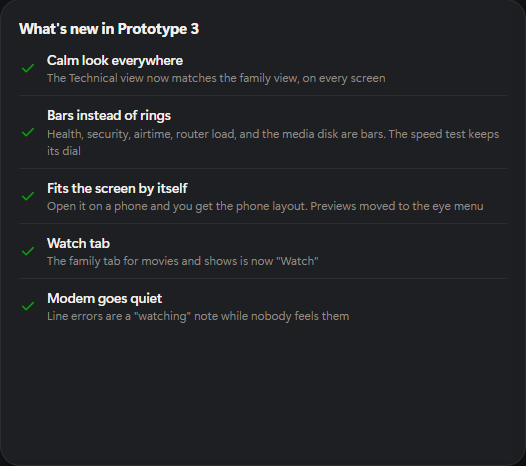
Four rounds of feedback
I reviewed the prototype in four rounds, and my answers overrode parts of the written plan. Two stand out:
- A device the hub doesn't recognize sees nothing but "not approved yet" and a button to ask for access.
- Both views have to work on a phone, a tablet, and a computer. Not just the family view.
Over the rounds, the look settled on a style we called Calm: quiet colors, plenty of space, and nothing flashing unless something's wrong. Modem errors, which looked alarming but weren't hurting anything people noticed, became a quiet "Watching" note instead of a red warning.
The gauges I took back
The first prototype used circular gauges, the kind you see on a car dashboard. I'd liked the idea. Seeing them on real data, I regretted it. Lines and bars are more versatile. They show change over time, they compare side by side, and they fit a phone screen.
So every ring became a bar. Only the speed test kept a dial, because a speed test really is a single reading.
Taking back my own idea after seeing it built was cheap at prototype stage. It would have been expensive later.
Built to be checked
Even the prototype came with checks. It had its own set of 710 logic tests, and all 22 of its pages, not just the seven technical ones, loaded with no errors. That habit, never shipping anything without checks, carried through every release after.
How you could try this
Ask for a working prototype on your own data before you commit to a design, and plan for a few short rounds of feedback. Expect to change your mind about something you asked for. I did.